If your business serves customers in Cardiff, Google Maps can be one of the most valuable places to be discovered. In this content I am going to explain how to rank higher on google maps
Someone searching for a plumber, solicitor, accountant, electrician, dentist or another local service may see Google Maps results before reaching traditional organic listings. At that point, your Business Profile becomes part of the customer’s first impression.
But ranking higher on Google Maps isn’t about adding Cardiff to your business name, collecting hundreds of directory links or finding a hidden Google Business Profile setting.
Google says local results are mainly determined by relevance, distance and prominence. It also makes clear that businesses cannot request or pay Google for better local rankings.
I’m Hridoy Chowdhury, an SEO Consultant specialising in Local SEO, Technical SEO, AEO, GEO, Entity SEO and AI Search Optimisation. In this guide, I’ll explain what those three ranking concepts mean and what Cardiff businesses can realistically work on.
How Does Google Decide Which Businesses Appear on Maps?
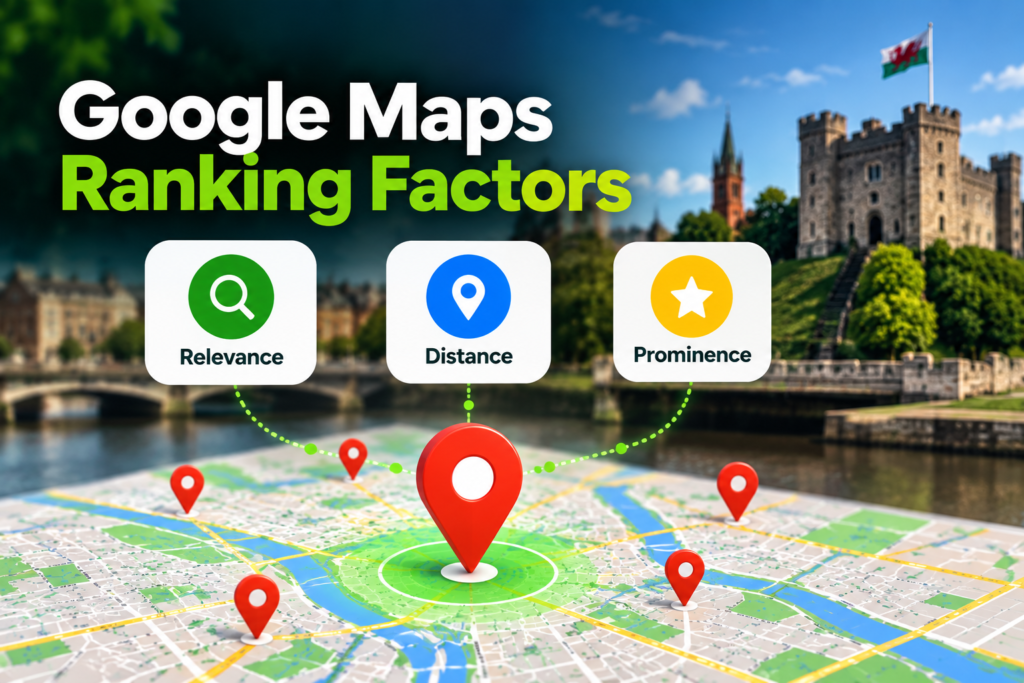
Google’s explanation gives us three useful starting points:
Relevance: How closely the business matches what someone is searching for.
Distance: How far the business is from the searcher, or from the location associated with the search.
Prominence: How well known or established the business appears to be.
Google considers these factors together rather than providing businesses with a simple checklist or fixed scoring system.
That distinction matters.
You can improve many signals connected with relevance and prominence. You cannot move your physical business closer to every potential customer in Cardiff.
A sensible Google Maps SEO strategy therefore concentrates on the factors you can genuinely influence.
1. Improve the Relevance of Your Google Business Profile
Relevance is essentially a matching problem.
If someone searches for a particular service, Google needs enough information to determine whether your business is a suitable match.
Google specifically recommends providing complete and detailed business information to help it understand a business and match it with relevant searches.
Start with the basics.
Your profile should accurately communicate:
- what your business is called
- what type of business it is
- what you provide
- where you are located or legitimately serve customers
- when you are open
- how customers can contact you
- which website represents the business
Completeness should not be confused with keyword stuffing.
Your goal is not to squeeze target phrases into every available field. Your goal is to describe the real business accurately enough that customers and Google can understand it.
2. Choose the Right Google Business Profile Categories
Categories are one of the clearest ways to tell Google what kind of business you operate.
Your primary category should represent the main business as accurately as possible. Additional categories can describe other legitimate parts of the business where appropriate.
For example, choosing a broad category simply because it sounds commercially attractive may make less sense than choosing the category that closely describes what customers actually hire you to do.
Don’t select unrelated categories just because competitors use them.
I prefer to ask:
What is this business actually known and hired for?
The profile should answer that question consistently.
3. Keep Your Business Information Accurate
Incorrect information creates a poor experience before a customer even reaches your website.
Check details such as:
- business name
- address where applicable
- telephone number
- website
- opening hours
- services
- relevant profile attributes
Google says complete and accurate information makes businesses more likely to appear for relevant local searches.
Google also builds Business Profile information from more than what the owner enters manually. Its documentation says information can come from publicly available web content, third-party data, user contributions and Google’s own interactions with places and businesses.
This is one reason consistency across your wider web presence matters.
4. Verify Your Google Business Profile
If your business is eligible for a Google Business Profile, verification is fundamental.
Google says verification establishes that you are authorised to represent the business and notes that verified businesses are more likely to appear in search results.
Verification does not guarantee rankings.
It establishes ownership and gives you the ability to manage important business information.
Google also recommends claiming your Business Profile so that you can manage information such as your address, contact information, business type and photos across Google Search and Maps.
5. Understand the Distance Factor
Distance is the ranking factor businesses have the least control over.
Google describes it as the distance between a potential search result and the location term used in the search. When a user doesn’t specify a location, Google can calculate distance based on what it knows about that user’s location.
Consider two people searching for the same service from different parts of Cardiff.
They don’t necessarily have to receive identical Maps results.
That is normal.
Can You Optimise for Distance?
Not in the same way that you optimise a title tag or service page.
Your physical location is your physical location.
Trying to manufacture addresses, virtual locations or misleading geographical signals is not a sensible substitute.
Instead, make sure Google has accurate information about where your legitimate business is located or operates, according to the rules that apply to your business type.
This is also why Maps rank tracking needs context. One ranking position measured from one Cardiff coordinate doesn’t necessarily describe your visibility across the entire city.
6. Build Prominence, Not Just Relevance
A business can be highly relevant to a query while still competing with several other relevant businesses.
This is where prominence becomes important.
Google describes prominence as how well known a business is. Its local ranking guidance specifically mentions information such as links to the business and reviews. Google also says that more reviews and positive ratings can help local ranking.
For me, this is where Local SEO becomes much broader than editing a Google Business Profile.
Prominence can involve your reputation, website, mentions and wider presence around the web.
7. Build a Genuine Review Strategy
Reviews serve two audiences.
Potential customers use them to judge whether they trust a business.
Google can also use review information as part of its local search systems.
Google explicitly states that review quantity and positive ratings can help local ranking.
That does not mean you should chase reviews at any cost.
A healthier approach is to make genuine feedback part of the normal customer journey.
Ask real customers for feedback at appropriate points. Make the process straightforward. Respond professionally where useful.
Avoid buying reviews or manufacturing customer experiences.
A smaller number of genuine reviews tells a much more sustainable story than an artificial reputation profile.
8. Don’t Ignore Your Website
Google Maps SEO isn’t confined to Google Maps.
Your website gives Google much more context about your business, services and expertise.
Google says Business Profile information can be compiled from publicly available information, including content crawled from a business’s official website.
That means I wouldn’t optimise a Cardiff business’s Google Business Profile while ignoring a weak website.
Your site should clearly explain:
Who are you?
What do you provide?
Who do you serve?
Where do you genuinely operate?
What makes the business credible?
How can somebody contact you?
Service pages should answer real customer questions rather than being built around repeated combinations of service + Cardiff.
9. Build Strong Service Pages
Imagine you provide several distinct services in Cardiff but your website explains all of them in two paragraphs on the homepage.
Your Google Business Profile may list the services, but the website provides little supporting information about them.
That is a missed opportunity.
Important services can justify dedicated pages when each page has genuine value and distinct search intent.
A useful service page might explain:
- what the service involves
- who needs it
- problems it addresses
- your process
- relevant experience
- location or service-area information
- pricing factors where appropriate
- common customer questions
- what happens next
The objective isn’t to produce a page for every keyword variation.
It’s to create the best page you reasonably can for a meaningful customer need.
10. Keep Business Information Consistent Across the Web
Your business may appear on your own website, Google Business Profile, social profiles, industry directories and other relevant websites.
Those references should describe the same real organisation.
Pay particular attention to core business details such as your name, address where applicable, phone number and website.
This is sometimes called NAP consistency, referring to Name, Address and Phone number.
I wouldn’t turn citation building into a numbers game.
Being listed on 300 irrelevant directories is not automatically better than having accurate information on the sources that genuinely matter to your business and customers.
The objective is clarity and consistency.
11. Earn Relevant Links and Mentions
Google specifically identifies links to a business as one of the signals associated with prominence.
That makes link acquisition relevant to Local SEO, but context matters.
For a Cardiff business, useful authority may come from legitimate relationships and relevant third-party sources rather than mass-produced links.
Depending on the business, opportunities might come from industry organisations, suppliers, partnerships, sponsorships, local organisations, useful resources or editorial coverage.
I would rather earn one meaningful reference than build dozens of links solely because a tool reports a particular metric.
12. Use Photos That Help Customers Understand the Business
Photos can help a potential customer understand what they are considering.
Google encourages businesses to add photos and videos to their profiles, and verified businesses can manage these profile elements.
Use genuine images where possible.
Depending on the business, useful photographs might show:
- premises
- team members
- completed work
- products
- facilities
- relevant equipment
- customer-facing areas
Think about what a real customer would want to see before choosing the business.
That is a better starting point than uploading images simply because somebody has labelled photo frequency a ranking hack.
13. Use LocalBusiness Structured Data Where Appropriate
Structured data can give Google explicit information about what a page represents.
Google’s documentation says LocalBusiness structured data can communicate details such as a business’s name, address, geographical coordinates, opening hours, telephone number and URL.
This does not mean adding schema will suddenly push a business into the Cardiff Map Pack.
Google doesn’t guarantee that structured data will produce a rich result, even when implemented correctly.
Think of schema as a way to make valid information more explicit, not as a ranking trick.
And make sure the structured data represents the real information visible on the website.
14. Strengthen Your Business Entity
This is an area of Local SEO I pay particular attention to.
Your business exists as more than a website URL or Google Maps pin.
Search systems can encounter information about it across your website, Google Business Profile, directories, professional profiles, reviews and other third-party sources.
Those signals should make it easier to understand:
Who is this business?
What does it do?
Where does it operate?
Which people are associated with it?
What supports its credibility?
Google itself explains that it uses information from multiple public and contributed sources to build business information.
That makes entity clarity a sensible part of modern Local SEO.
15. Don’t Create Thin Cardiff Location Pages
Location pages can be useful.
Thin location pages are another matter.
If a business genuinely operates across several locations or service areas, dedicated pages may make sense when they provide useful information specific to those customers.
But changing:
Electrician in Cardiff
to:
Electrician in Newport
and then:
Electrician in Swansea
while keeping almost everything else identical does not suddenly create three useful resources.
Before creating a location page, ask:
What useful information can I give someone searching for this service in this location that isn’t already available elsewhere on the site?
If there isn’t a convincing answer, reconsider whether the page needs to exist.
16. Google Maps SEO Is Not Only About Rankings
I don’t like judging Local SEO solely by one Maps ranking screenshot.
Suppose rankings improve but:
- nobody calls
- visitors aren’t relevant
- the website doesn’t convert
- enquiries come from the wrong areas
- leads are for low-value services
That campaign still has a business problem.
The measurement framework I prefer is:
Visibility → Qualified Traffic → Trust → Leads → Customers → Revenue
Rankings help us understand visibility.
They are not the final business outcome.
17. Can You Pay Google for Better Maps Rankings?
Not through Local SEO.
Google explicitly states that there is no way to request or pay for a better local ranking.
Advertising and organic/local ranking systems should not be confused.
Be cautious if somebody promises that paying them gives them special access to guaranteed organic Google Maps positions.
18. How Long Does It Take to Rank Higher on Google Maps?
There isn’t a universal timeframe.
A business starting with an incomplete profile, weak website and inconsistent information faces a different situation from an established business with years of reviews and authority.
Competition also differs by industry and location.
Rather than promising a fixed timeframe, I would establish the starting position, identify the highest-impact problems and measure progress from there.
19. Can a Cardiff Business Rank Across the Whole City?
Visibility can vary depending on where the person searching is located because distance is one of Google’s stated local ranking factors.
So the question isn’t simply:
What position do I rank in Cardiff?
A better analysis asks:
- Which searches are generating visibility?
- From which areas?
- For which services?
- Which competitors appear?
- Are impressions turning into meaningful actions?
- Are those actions generating qualified enquiries?
That gives you a much more useful view of local search performance.
20. What Should Cardiff Businesses Prioritise First?
If I were reviewing a business with weak Google Maps visibility, I wouldn’t begin by ordering hundreds of citations or rewriting every page.
I would establish the basics first:
- Is the business eligible for and properly represented by its Google Business Profile?
- Is the profile verified?
- Is the business information complete and accurate?
- Are the categories appropriate?
- Does the website clearly explain the important services?
- Is business information consistent?
- Are there genuine customer reviews?
- Does the business have relevant authority and third-party references?
- Are important pages technically accessible and indexable?
- Is performance being measured properly?
Then I would prioritise according to what the evidence shows.
Google Maps SEO and AI Search (How To Rank Higher On Google Maps)
Local discovery is expanding beyond traditional Google results.
People can now research businesses through conversational and AI-assisted experiences as well as Search and Maps.
I don’t think this makes Local SEO obsolete.
It makes clear, trustworthy business information even more important.
Google already explains that it gathers business information from official websites, business owners, public web sources, third-party data and user contributions.
For modern search visibility, I therefore pay attention to:
- technically accessible information
- clear business entities
- useful service content
- consistent business details
- structured information
- genuine reviews
- relevant authority
- third-party validation
These principles overlap with Local SEO, Entity SEO, AEO, GEO and AI Search Optimisation.
There is no legitimate guarantee that improving them will cause ChatGPT, Gemini, Copilot or Google AI Overviews to recommend a particular business.
The goal is to make the business easier for people and search systems to understand and verify.
Final Thoughts
If you want to rank higher on Google Maps in Cardiff, focus first on what Google itself says matters: relevance, distance and prominence.
You can’t optimise away physical distance.
You can improve how accurately your business is represented, how clearly your website explains your services, how customers review the business, how consistent its information is and how much legitimate authority surrounds it.
That is a much stronger foundation than looking for a Google Maps ranking trick.
Need Help With Local SEO in Cardiff?
I’m Hridoy Chowdhury, a London-based SEO Consultant, AEO, GEO & AI Search Specialist with more than 7 years of SEO experience across 3,500+ SEO projects. I’m Top Rated Plus on Upwork with a 98% Job Success Rate and have trained more than 50,000 learners.
If you want help reviewing your Google Business Profile, website and wider local search presence, explore my Local SEO Cardiff service or get in touch to discuss your business.